
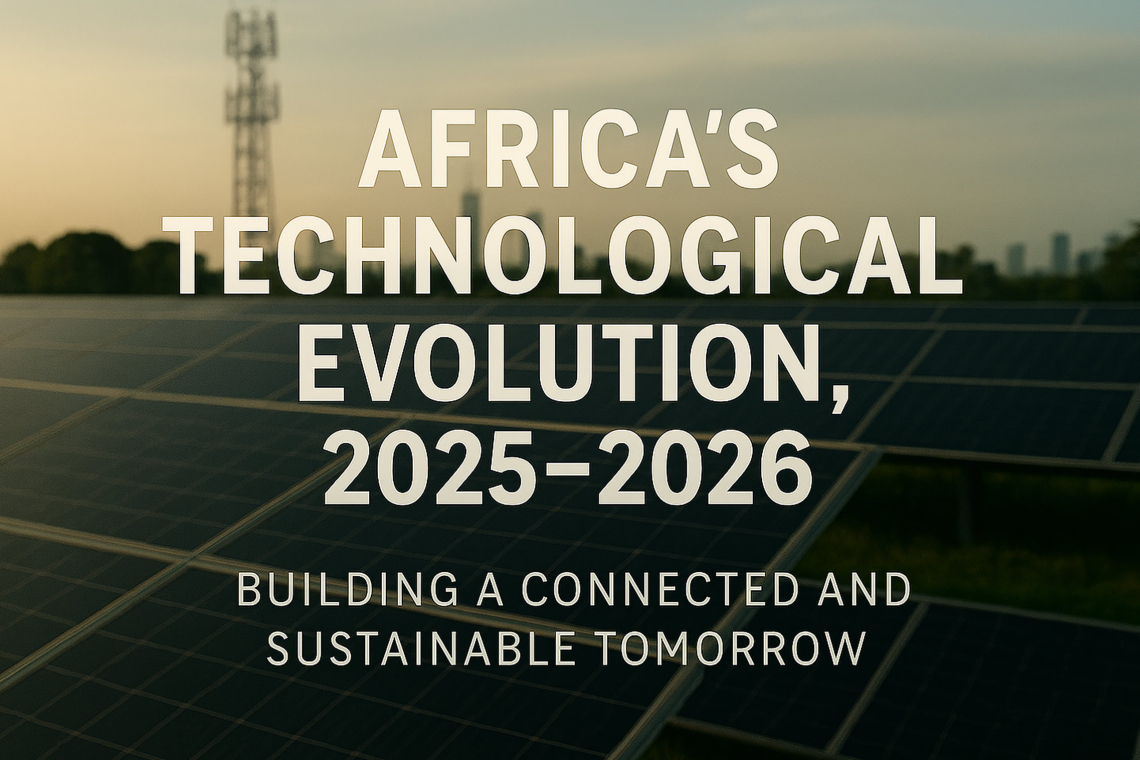
From 2025 through 2026, Africa has entered a defining period of rapid technological progress. Momentum across digital transformation, artificial intelligence, financial innovation, renewable energy, and advanced connectivity has repositioned the continent. Long seen mainly as a consumer of external technologies, Africa is increasingly emerging as a proving ground for scalable, impact‑focused solutions capable of addressing both regional needs and global challenges.
Digital Transformation as a Catalyst for Economic Growth
Digital infrastructure remains a cornerstone of Africa’s development trajectory. The International Telecommunication Union (ITU) emphasizes that digital technologies are now central to economic resilience, inclusive growth, and modern service delivery across the continent. Although persistent challenges such as affordability and last‑mile connectivity remain, tangible progress accelerated in 2025 as national governments and regional institutions aligned more closely with the African Union’s Digital Transformation Strategy (2020–2030).
The World Economic Forum highlights that Africa’s digital economy is no longer simply narrowing the gap with advanced markets but is leapfrogging legacy systems, particularly in digital payments, public administration, and cross‑border commerce. By 2025, mobile payment platforms supported more than 1.1 billion users and processed over $1 trillion in transactions, drawing millions into the formal financial system. Industry analysts characterize 2025 as a year of strategic reset. The narrative shifted away from rapid deployment toward impact‑driven digital development, prioritizing inclusion, resilience, and long‑term sustainability over novelty alone.
Artificial Intelligence Evolves Into Foundational Infrastructure
Artificial intelligence adoption across Africa gained significant momentum in 2025 and continued to expand into 2026, especially within banking, telecommunications, healthcare, and public‑sector operations. Regulatory authorities in countries including Nigeria, Kenya, South Africa, and Ghana introduced clearer AI governance frameworks, designed to encourage innovation while managing operational and ethical risks an approach that strengthened institutional confidence and investor participation.
Financial institutions and fintech firms increasingly rely on AI for fraud prevention, credit assessment, customer onboarding, and real‑time analytics. Analysts note that AI has shifted from being a differentiator to becoming core digital infrastructure, enabling organizations to scale trust and efficiency in environments where traditional data sources are often incomplete or fragmented.
Fintech and Digital Finance Enter a Phase of Maturity
Fintech continues to stand as Africa’s most developed technology vertical, representing approximately 40% of total startup funding in 2025, according to TechCabal Insights. While overall venture funding became more selective, capital gravitated toward revenue‑generating and infrastructure‑centric platforms, signaling consolidation and market maturity rather than decline.
Looking into 2026, innovations such as embedded finance, open banking frameworks, stablecoins, and regulated cross‑border payment systems are reshaping access to financial services. Locally developed solutions remain dominant, reflecting Africa‑specific market conditions rather than imported models. Industry leaders anticipate increased regulatory harmonization and interoperability across regions through 2026.
Rapid Expansion in Clean Energy and Green Technologies
Africa’s technological momentum is closely linked to its accelerating clean‑energy transition. In 2025, private investment in renewable energy nearly tripled to about $40 billion, while more than 21 million people gained access to electricity through coordinated initiatives involving governments, development institutions, and private investors. Solar power has emerged as a standout success. The Africa Solar Outlook 2026 identified 2025 as a milestone year characterized by record installations, declining costs, and the growth of local solar manufacturing. At the same time, advancements in battery energy storage systems (BESS) are mitigating intermittency challenges, enabling solar projects to compete with conventional baseload generation. Energy analysts increasingly view 2026 as a breakout year for Africa’s clean‑energy leadership, supported by international climate‑finance commitments and a shift toward decentralized, technology‑enabled power systems.
Satellite and Next‑Generation Connectivity Drive Digital Inclusion
Connectivity advanced significantly in late 2025 following announcements of satellite‑to‑mobile services scheduled for deployment across Africa in 2026. Collaborations between global satellite providers and African telecom operators will allow standard smartphones to connect in areas lacking terrestrial infrastructure, with the potential to reach over 170 million people across multiple countries. This development marks a structural shift for rural economies, emergency response capabilities, and cross‑border digital services. Observers describe satellite‑to‑cell connectivity as one of the most consequential advancements in Africa’s digital ecosystem since the early expansion of mobile broadband.
Conclusion: Transitioning From Adoption to Leadership
The 2025–2026 period clearly signals Africa’s transition from technology adoption to technology‑enabled leadership. Across digital finance, artificial intelligence, renewable energy, and connectivity, the continent is using innovation to bypass outdated systems and design solutions aligned with its demographic scale and economic realities. While gaps in infrastructure, skills, and affordability persist, the direction of travel is unmistakable. Africa is no longer merely participating in the global technology narrative it is increasingly shaping it, offering practical models for inclusive, resilient, and sustainable growth in the digital era.
Found this article interesting? Follow us on X(Twitter) ,Threads and FaceBook to read more exclusive content we post.