
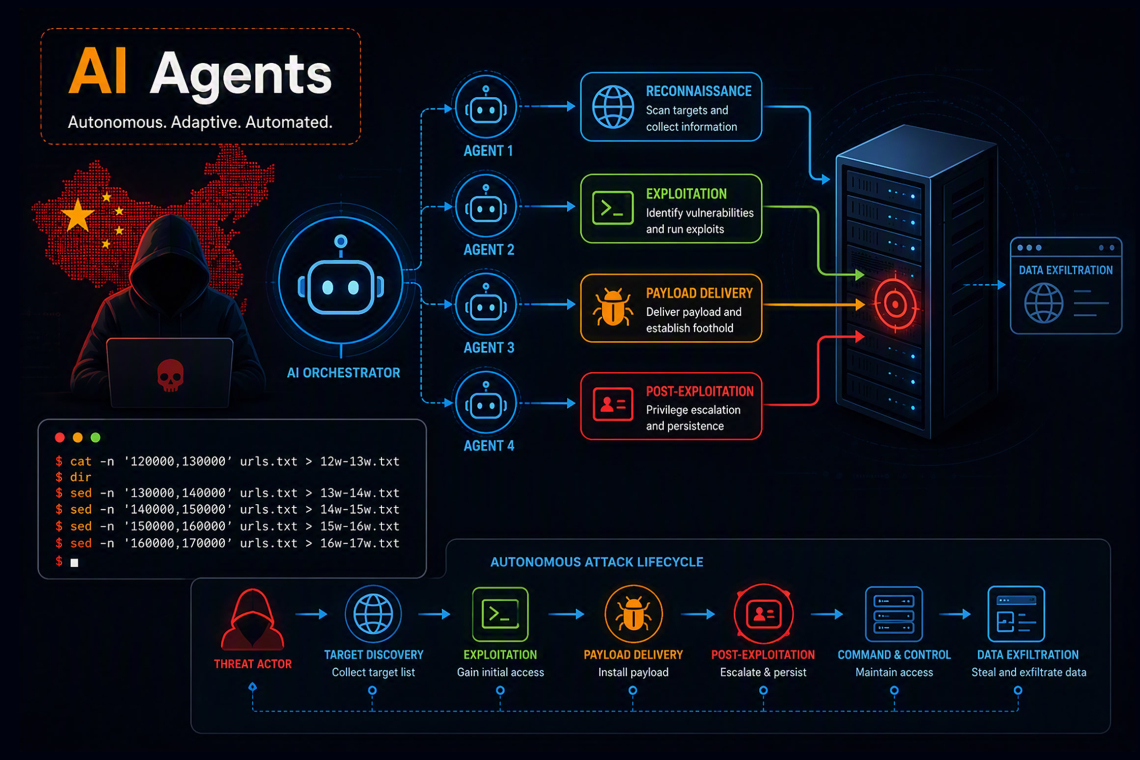
A Chinese-speaking cybercrime organization has been observed using AI-assisted tools to exploit vulnerable web servers, highlighting how artificial intelligence is accelerating and scaling traditional attack methods. Rather than relying solely on novel vulnerabilities, the group is using AI to automate many stages of the intrusion process, making familiar security flaws far more dangerous.
The threat actor, tracked as UAT-10147, has targeted internet-facing Windows and Linux systems across multiple sectors, including government, education, media, technology, and gaming. Victims have been identified in several countries, while investigators discovered a related server containing approximately 170,000 target URLs, indicating a large-scale operation.
Researchers at Cisco Talos uncovered the campaign and determined that the attackers combined publicly available exploits with AI-generated scripts, operational guidance, troubleshooting procedures, and testing workflows. According to a report shared with Cyber Security News (CSN), this methodology has enabled the group to execute sophisticated intrusions more efficiently and at a much larger scale.
.webp)
The growing concern is not simply the exploitation of known vulnerabilities, but the speed and effectiveness with which AI can automate the attack lifecycle. AI-powered assistants can help threat actors scan targets, modify failed exploits, verify payload execution, collect system information, and establish persistent access with significantly less manual effort.
AI as an Operational Force Multiplier
Cisco Talos found evidence that UAT-10147 uses AI as an operational assistant throughout the attack process rather than as a single-purpose automation tool. Investigators identified AI-generated playbooks, exploit scripts, troubleshooting logic, and validation procedures that supported activities both before and after system compromise.
.webp)
The group integrated these AI-assisted workflows with established offensive frameworks, enabling operators to rapidly identify vulnerabilities, generate payloads, validate results, and determine follow-up actions. This approach reflects growing concerns about the security implications of increasingly capable AI agents in offensive cyber operations.
Exploitation of Known Vulnerabilities
Initial access was obtained through the exploitation of publicly known remote code execution (RCE) vulnerabilities affecting platforms such as Zimbra, AjaxPro, Nacos, and Telerik. These vulnerabilities provided attackers with direct entry points into exposed web servers.
On Windows systems, the attackers deployed BadIIS, a malicious Internet Information Services (IIS) module commonly associated with search-result manipulation and unauthorized server control. Additional scripts were used to escalate privileges, weaken security monitoring around IIS directories, create high-level access accounts, and maintain persistence after the initial breach.
Linux environments were compromised using a similar methodology. Following the deployment of web shells, the group exploited local privilege escalation vulnerabilities, including Dirty Pipe, to obtain root privileges and install additional malicious components.
Automation Across the Full Attack Chain
Analysis of recovered materials suggests AI played a role far beyond simple code generation. One AI-produced guide outlined a detailed process for exploiting ASP.NET ViewState deserialization, covering everything from validating stolen configuration keys to generating payloads and confirming successful execution while minimizing visible indicators.
Additional automated scripts were designed to identify writable directories, map IIS environments, deploy malware, install web shells, and collect execution results through callback mechanisms. When an attack encountered obstacles, the workflow could diagnose errors and recommend alternative methods, reducing the need for human intervention.
.webp)
Researchers also observed the attackers using a cloud-based configuration service to gather victim information following the exploitation of Nacos servers. By blending reconnaissance activities into seemingly legitimate web traffic, the group made detection more challenging for security teams.
Defensive Recommendations
Organizations should prioritize the security of internet-facing web servers and applications. Key defensive measures include:
- Promptly applying security patches to publicly exposed systems.
- Minimizing unnecessary internet exposure.
- Monitoring IIS and application configuration changes.
- Investigating unusual scheduled tasks, newly created accounts, and unexpected outbound connections.
- Reviewing security exclusions and privileged access settings.
- Protecting ASP.NET MachineKey credentials and other sensitive configuration secrets.
- Examining unexplained server errors that may indicate attempted deserialization attacks.
In particular, unusual error responses can reveal reconnaissance activities associated with ViewState exploitation attempts, while strict control of administrative interfaces can reduce the risk of server takeover.
A New Stage in Cybercrime Operations
While AI has not made cyberattacks entirely autonomous, this campaign demonstrates how financially motivated threat actors can use AI to improve efficiency, automate routine tasks, and accelerate the transition from vulnerability discovery to successful compromise.
The core lesson for defenders remains unchanged: reduce the attack surface before attackers can reach it. Maintaining accurate asset inventories, applying security updates, safeguarding credentials, and continuously monitoring web server activity remain critical defenses against increasingly automated cyber threats.
Note: All IP addresses and domains referenced in original threat intelligence materials were intentionally defanged to prevent accidental resolution or hyperlink activation. Any reactivation should only be performed within controlled security analysis platforms such as MISP, VirusTotal, or SIEM environments.
Found this article interesting? Follow us on X(Twitter) ,Threads and FaceBook to read more exclusive content we post.
