
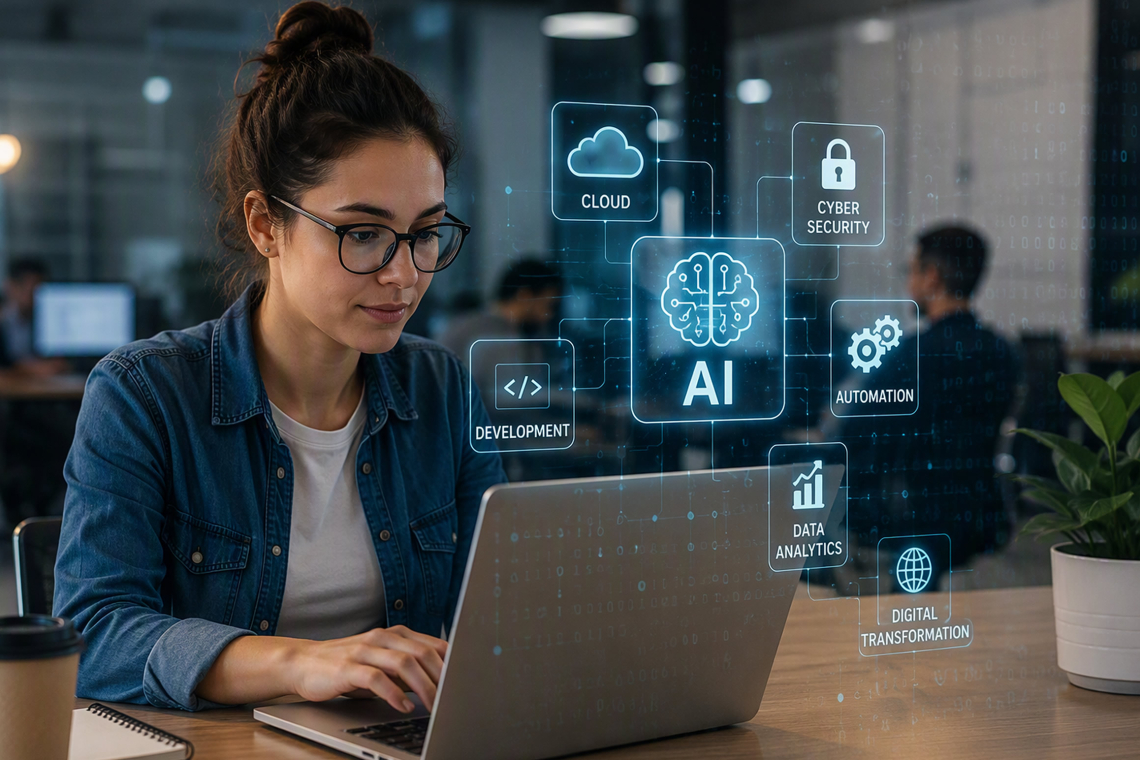
We are living through one of the most significant technological transformations in human history. Just as the Industrial Revolution changed how people worked, traveled, and lived, today's digital revolution is reshaping nearly every aspect of modern society. From how businesses operate and communicate to how students learn and consumers shop, technology has become deeply embedded in everyday life.
Not long ago, concepts such as Artificial Intelligence (AI), cloud computing, automation, cybersecurity, and digital transformation were largely confined to technology departments and research laboratories. Today, these technologies influence healthcare, finance, education, manufacturing, government services, and even personal decision-making.
The rapid pace of technological advancement can often be overwhelming, especially for those without technical backgrounds. New buzzwords emerge regularly, companies announce groundbreaking innovations, and media headlines frequently discuss cyberattacks, AI breakthroughs, and digital disruptions. As a result, many people understand that technology is changing the world but struggle to understand exactly how and why.
The reality is that technology literacy is no longer optional. Understanding the basic concepts behind modern IT has become as important as understanding financial literacy or communication skills. Regardless of whether someone is a student planning a career, a professional seeking advancement, an entrepreneur building a business, or simply a curious individual, gaining an understanding of today's technology trends provides a major advantage in navigating the modern world.
Technology is no longer merely supporting business operations. It has become the foundation upon which modern organizations build competitive advantage, drive innovation, and create value. The companies that successfully embrace emerging technologies often outperform competitors, while individuals who develop digital skills place themselves in a stronger position for future career opportunities.
The following sections explore the major developments shaping the technology landscape today and explain why they matter to both businesses and everyday individuals.
Artificial Intelligence Is Changing Everything
No technological advancement has captured public attention more than Artificial Intelligence. Once considered a futuristic concept found only in science fiction movies, AI has become one of the most transformative forces in modern society.
Artificial Intelligence refers to computer systems capable of performing tasks that typically require human intelligence, such as understanding language, recognizing patterns, solving problems, generating content, and making recommendations.
Today, AI-powered tools such as:
- Microsoft Copilot
- ChatGPT
- Google Gemini
- Claude
- Perplexity
- GitHub Copilot
are helping millions of people become more productive.
These systems can:
- Draft professional emails
- Generate business reports
- Write software code
- Analyze large datasets
- Summarize lengthy documents
- Create marketing content
- Assist with research
- Generate images and presentations
Tasks that previously required hours of work can often be completed in a matter of minutes.
For businesses, this creates tremendous opportunities. Organizations can automate repetitive processes, improve efficiency, reduce costs, and enable employees to focus on more strategic tasks.
However, AI also raises important questions.
Many workers worry that automation may eliminate jobs. While some routine tasks will undoubtedly become automated, history suggests that technological change typically creates new roles as it transforms existing ones.
The biggest advantage will likely belong to individuals who learn how to collaborate with AI effectively.
The future workforce will not necessarily be divided between humans and machines. Instead, it will consist of professionals who know how to leverage AI tools and those who do not.
In many ways, learning AI today is comparable to learning how to use a computer during the 1990s or the internet during the early 2000s. Those who embrace the technology early are likely to benefit the most.
Cybersecurity Threats Are Increasing
As technology continues to connect people, devices, and organizations, cybercrime has emerged as one of the greatest challenges of the modern era.
Nearly every organization today depends on digital systems to operate. Unfortunately, where valuable data exists, attackers are not far behind.
Major cyber threats include:
- Ransomware attacks
- Phishing campaigns
- Business email compromise
- Identity theft
- Data breaches
- Insider threats
- Supply chain attacks
- Cloud security breaches
Cybercriminals have become highly sophisticated. Rather than relying solely on technical hacking skills, many attacks now combine advanced technology with human psychology.
Artificial Intelligence has further amplified these risks.
Attackers can now generate highly convincing phishing emails, clone executive voices using AI, produce realistic deepfake videos, and automate reconnaissance operations at scale.
What once required dedicated hacking teams can increasingly be performed using automated tools.
As a result, cybersecurity has evolved from a technical concern into an organizational priority.
Companies are investing heavily in:
- Security Operations Centers (SOCs)
- Zero Trust architectures
- Cloud security platforms
- Threat intelligence programs
- Identity protection systems
- Security automation solutions
Cybersecurity professionals are among the most sought-after specialists in today's workforce because the financial and reputational consequences of cyberattacks can be devastating.
In short, cybersecurity is no longer simply about protecting computers. It is about protecting businesses, customers, reputations, and entire economies.
Cloud Computing Has Become the Foundation of Modern Business
One of the biggest changes in technology over the past decade has been the shift from traditional on-premises infrastructure to cloud computing.
Historically, businesses purchased expensive servers and hosted data inside their own facilities. Maintaining this infrastructure required dedicated IT teams, significant budgets, and ongoing maintenance.
Cloud computing changed everything.
Modern organizations increasingly rely on platforms such as:
- Microsoft Azure
- Amazon Web Services (AWS)
- Google Cloud Platform (GCP)
Instead of owning physical infrastructure, companies can rent computing power, storage, databases, and networking services from cloud providers.
The benefits are substantial:
Scalability
Organizations can instantly increase or decrease resources based on demand.
Cost Efficiency
Businesses only pay for what they use rather than investing heavily in hardware.
Accessibility
Employees can securely access resources from anywhere.
Reliability
Cloud providers offer redundancy and disaster recovery capabilities that are often difficult for individual organizations to replicate.
Today, many of the applications people use daily are cloud-based, including:
- Microsoft 365
- Gmail
- Netflix
- Salesforce
- Dropbox
- Zoom
Cloud computing has become so dominant that cloud skills now rank among the most valuable capabilities in the technology job market.
Remote and Hybrid Work Are Permanently Reshaping Employment
The traditional concept of work centered around a physical office is rapidly evolving.
Many organizations now embrace:
- Fully remote work
- Hybrid work arrangements
- Flexible scheduling models
Advances in cloud computing and collaboration technologies have made this possible.
Employees can now communicate and collaborate using:
- Microsoft Teams
- Zoom
- Slack
- SharePoint
- Google Workspace
This flexibility has transformed employee expectations and business operations.
Organizations can recruit talent from broader geographic regions while employees enjoy improved work-life balance and reduced commuting time.
However, remote work also introduces significant challenges.
Corporate networks now extend beyond office walls, requiring organizations to secure:
- Home networks
- Smartphones
- Laptops
- Tablets
- Cloud services
Security teams must ensure that sensitive data remains protected regardless of where employees work.
Automation Is Transforming the Nature of Work
Automation is another major force driving business transformation.
Organizations increasingly leverage software to perform routine and repetitive tasks.
Examples include:
- Data entry
- Customer support interactions
- Invoice processing
- IT system monitoring
- Software deployment
- Report generation
The objective is not simply reducing labor costs but improving accuracy, consistency, and efficiency.
As automation handles repetitive activities, employees are increasingly expected to focus on areas requiring uniquely human skills:
- Critical thinking
- Creativity
- Leadership
- Collaboration
- Innovation
- Strategic planning
This shift is reshaping workforce development programs and educational priorities across industries.
The most successful professionals will likely be those who combine technical understanding with strong human-centered skills.
The Demand for Technology Skills Continues to Grow
Despite economic uncertainty in some sectors, technology remains among the fastest-growing career fields globally.
The most in-demand areas include:
Artificial Intelligence
Professionals capable of implementing AI solutions, training models, and integrating AI into business operations are highly sought after.
Cybersecurity
Organizations consistently seek experts in:
- Threat detection
- Incident response
- Identity management
- Cloud security
- Security engineering
Cloud Computing
Azure, AWS, and Google Cloud certifications continue to hold significant value.
Data Analytics
Business leaders increasingly rely on data-driven insights, creating demand for:
- Power BI specialists
- Data analysts
- Python developers
- Business intelligence professionals
Software Development
Software remains the engine of digital innovation, fueling demand for developers skilled in modern programming frameworks and DevOps practices.
Technology professionals who combine technical expertise with communication and business knowledge often enjoy the strongest career opportunities.
Digital Transformation Is Reshaping Every Industry
Digital transformation refers to the integration of technology into every aspect of business operations.
Organizations are replacing manual, paper-based, and fragmented processes with digital solutions.
Examples include:
- AI-powered customer service
- Electronic medical records
- Digital banking platforms
- Smart manufacturing systems
- Online education environments
Industries experiencing significant transformation include:
- Healthcare
- Banking
- Retail
- Education
- Manufacturing
- Government
Businesses that successfully embrace digital transformation often achieve:
- Greater efficiency
- Improved customer experiences
- Reduced costs
- Better decision-making
Organizations that resist modernization risk losing competitiveness in increasingly digital markets.
Data Has Become the World's Most Valuable Resource
Data is frequently described as the new oil of the digital economy.
Every online transaction, website visit, mobile app interaction, and social media activity generates data.
Businesses use this information to:
- Understand customer behavior
- Improve products and services
- Predict future trends
- Detect fraud
- Optimize operations
- Improve marketing effectiveness
As data volumes continue to grow, organizations increasingly depend on professionals who can transform raw information into meaningful insights.
This demand drives opportunities in:
- Data science
- Data analytics
- Business intelligence
- Predictive modeling
Organizations that effectively use data often outperform competitors that rely solely on instinct and assumptions.
The Technology Skills Gap Remains a Global Challenge
Ironically, despite technology's growth, many organizations struggle to find qualified professionals.
There are significant shortages in areas such as:
- Cybersecurity
- AI engineering
- Cloud architecture
- Software development
- Data analytics
One reason is that technology evolves faster than traditional education systems.
Skills that are highly valuable today may require updates within only a few years.
For this reason, continuous learning has become essential.
Successful professionals no longer view education as something that ends after graduation. Instead, learning becomes a lifelong commitment.
What Beginners Should Focus On
For individuals just starting their technology journey, the sheer number of available topics can seem overwhelming.
The best approach is to begin with foundational knowledge.
Learn Networking Fundamentals
Understand:
- IP addresses
- DNS
- Routers
- Internet communication
Explore Cloud Fundamentals
Begin with:
- Azure Fundamentals (AZ-900)
- AWS Cloud Practitioner
Understand Cybersecurity Basics
Learn about:
- Password security
- Phishing attacks
- Multifactor authentication
- Data privacy
Experiment With AI
Use tools such as:
- Microsoft Copilot
- ChatGPT
- Gemini
to understand how AI can improve productivity.
Strengthen Digital Literacy
Become comfortable with:
- Online collaboration tools
- Cloud storage
- Spreadsheets
- Data visualization
- Workflow automation
Building strong foundations creates pathways into more advanced technology specialties later.
Conclusion
The world is entering an era where technology touches nearly every aspect of daily life and business. Artificial Intelligence, cloud computing, cybersecurity, automation, digital transformation, and data analytics are no longer niche technical topics. They are driving forces behind economic growth, organizational strategy, and workforce evolution.
For beginners, the goal should not be to master every technology overnight. Instead, it should be to develop awareness, curiosity, and a commitment to continuous learning. The individuals and organizations that thrive in the coming decade will be those that embrace change rather than resist it.
Technology is no longer simply supporting the world around us. It is actively shaping how we work, communicate, learn, create, and solve problems. Understanding these trends today is one of the smartest investments anyone can make in preparing for the future.
Found this article interesting? Follow us on X(Twitter) ,Threads and FaceBook to read more exclusive content we post.
