
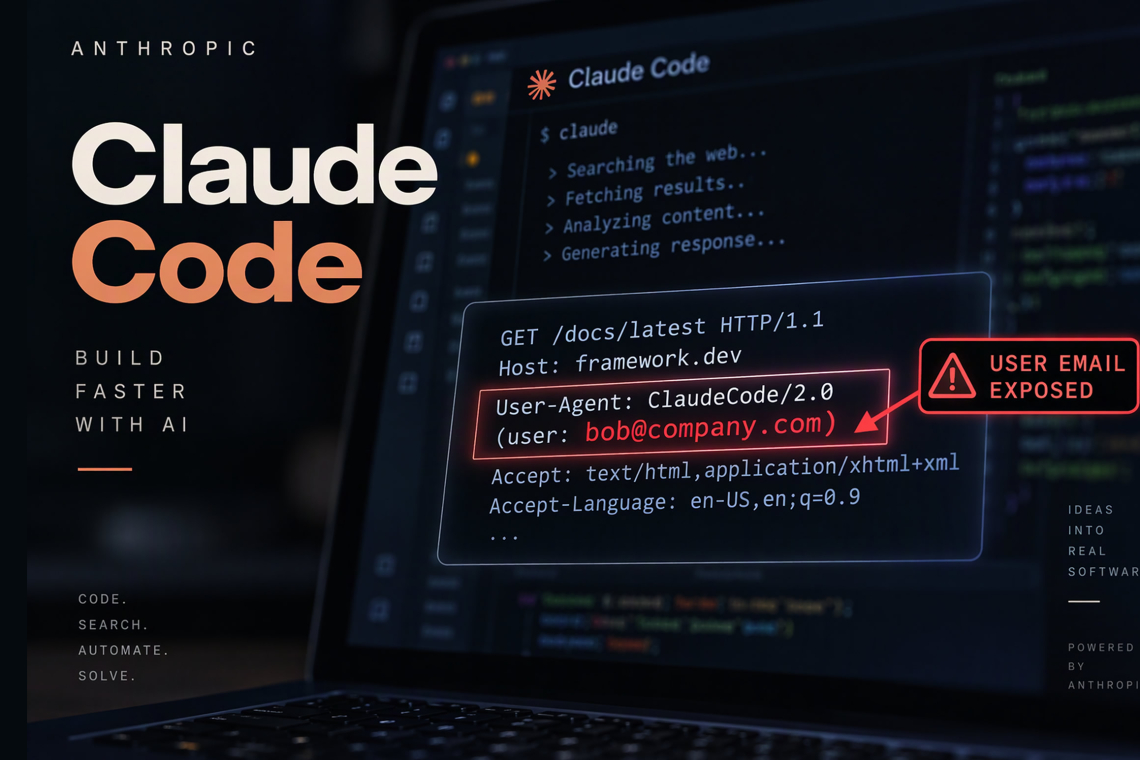
Anthropic's AI-powered coding assistant, Claude Code, has come under fire after claims surfaced that the tool may have inadvertently exposed users' email addresses to third-party websites through HTTP User-Agent headers during web-based operations. The allegation has sparked fresh concerns about data privacy and the safeguards AI coding agents employ when interacting with external services on behalf of users.
The controversy emerged on November 5, 2026, when GitHub user taylor-edwards reported the issue, alleging that Claude Code had been transmitting their account email address as part of HTTP request headers without explicit authorization. According to the report, the user subsequently began receiving a large volume of unsolicited and potentially fraudulent emails, claiming the number had escalated to dozens of spam and scam messages each day.How the Alleged Exposure Could Occur
The HTTP User-Agent header is typically used to identify the client software responsible for making a web request. It often contains information such as the application name, version number, and operating environment. However, if personal information such as an email address becomes embedded within that header, the information is automatically shared with every website that receives the request.
As a result, the issue is being viewed primarily as a potential privacy and data-handling concern rather than a breach involving unauthorized access to Anthropic systems or customer databases. In this scenario, sensitive information would be exposed through normal web communications rather than through a direct compromise of backend infrastructure.
Discussion within the GitHub thread suggests that the behavior may be linked to AI-generated commands written by Claude itself. Participants referenced situations where the model, having access to a user's email address within its working context, may have inserted that address into a curl command as a contact identifier while constructing HTTP requests. If accurate, this would indicate an unintended consequence of model-generated code rather than a deliberate product feature.Privacy Safeguards Questioned
During the discussion, contributor poteat stated that Claude Code versions 2.1.317 and newer include a built-in privacy protection mechanism known as cc-plugin-privacy. According to the explanation, the module is enabled by default and is specifically designed to prevent AI-generated actions from exposing sensitive information. The protection can reportedly be managed through Claude Code's plugin framework.
However, questions quickly arose regarding the effectiveness of those safeguards. Notably, the original report involved version 2.1.318, a release that should already have included the privacy module. Several users participating in the discussion reported difficulties locating the plugin or confirming that it was actively functioning.
Some participants conducted local, non-production tests using sample prompts containing both email addresses and User-Agent strings. While these tests did not transmit real personal information to external destinations, users claimed the generated output was not blocked as expected, raising doubts about whether the privacy controls were consistently enforced.Those observations have fueled broader concerns about the reliability of current guardrails designed to prevent sensitive data leakage from AI-assisted development tools, particularly when models are given permission to generate and execute network-related commands.
Anthropic Plans Additional Changes
Further discussion referenced comments attributed to a Claude Code team member indicating that Anthropic intends to remove account email addresses from the model's accessible context in a future software update. The same comments reportedly acknowledged limitations in the existing protections and suggested that additional improvements were already under development.
At the time the issue was reviewed, the GitHub report remained open, indicating that investigation and remediation efforts were still ongoing.Security Lessons for Organizations
The incident serves as another reminder that AI agents capable of generating code, executing commands, and interacting with external services require rigorous oversight. Organizations deploying tools such as Claude Code should closely inspect AI-generated network requests, audit outbound communications, and validate privacy protections through independent testing rather than relying solely on vendor assurances.
Security teams should also implement layered safeguards, including outbound traffic monitoring, data-loss prevention (DLP) controls, command review processes, and strict restrictions on what personal information can be made available to AI systems. As AI coding assistants become increasingly autonomous, preventing inadvertent data disclosure will remain just as critical as defending against traditional cyberattacks.
Ultimately, the allegations highlight a broader industry challenge: the presence of a security or privacy feature does not automatically guarantee that sensitive data cannot be exposed. Continuous verification, testing, and transparency remain essential components of secure AI adoption.
Found this article interesting? Follow us on X(Twitter) ,Threads and FaceBook to read more exclusive content we post.
