

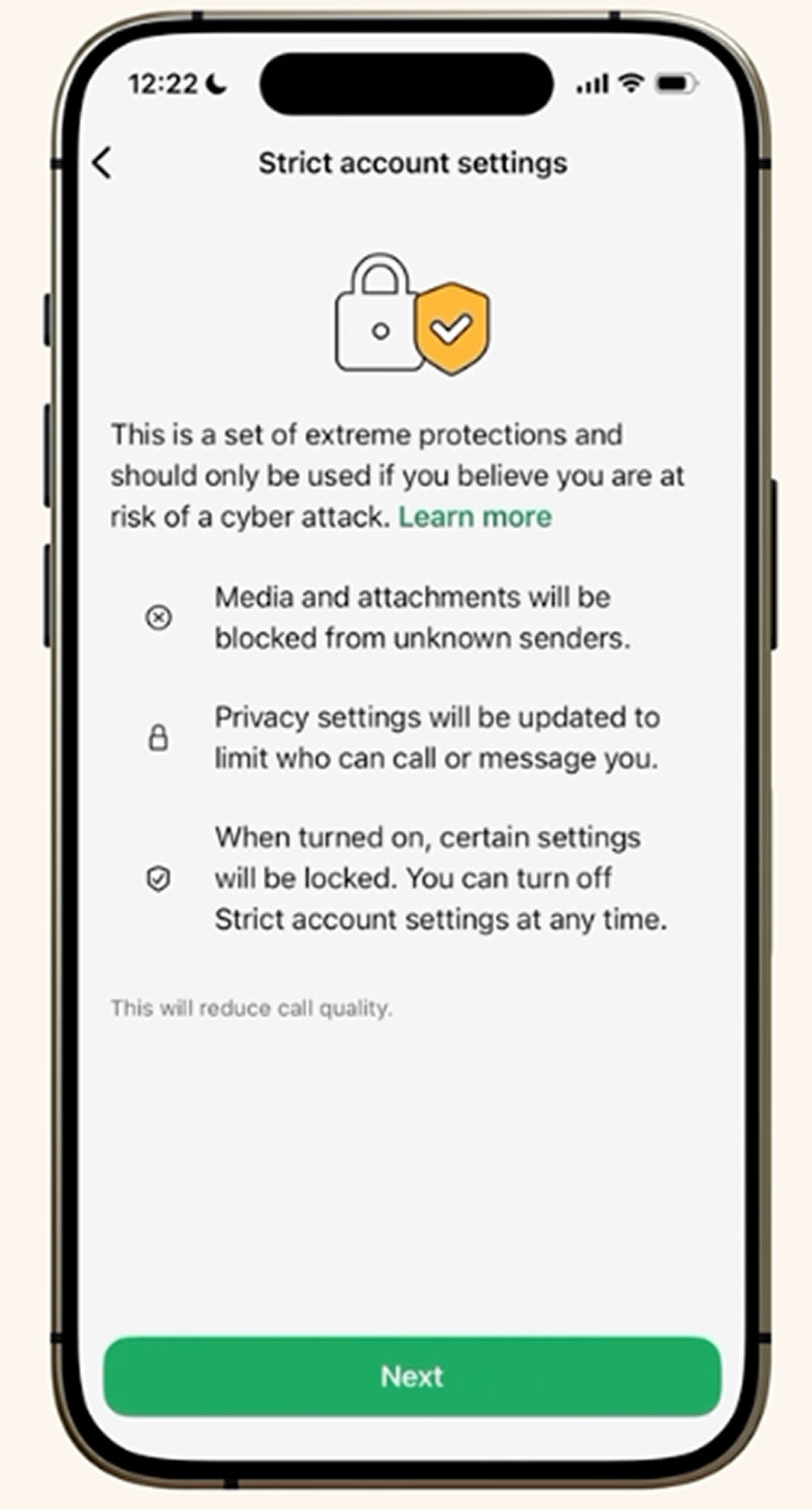
Meta announced on Tuesday that WhatsApp is introducing a new Strict Account Settings option designed to protect users who may be at heightened risk of targeted cyberattacks due to their profession, visibility, or public role.
The new capability functions similarly to Apple’s Lockdown Mode and Android’s Advanced Protection, offering an extra‑secure environment for users such as journalists, activists, and other individuals who may face sophisticated spyware threats. To achieve this, the feature limits certain app functions in exchange for stronger, more restrictive security controls.
Once activated, Strict Account Settings automatically enforces the highest‑security configurations, including blocking attachments and media sent by people outside the user’s contact list.
“This lockdown‑style feature strengthens your security on WhatsApp with just a few taps by locking your account to the most restrictive settings such as automatically blocking attachments and media from unknown senders, silencing calls from people you don’t know, and applying additional limitations that may reduce how the app typically functions,” Meta explained.
Users can enable the feature by navigating to Settings → Privacy → Advanced. Meta noted that the rollout will happen gradually over the coming weeks. Alongside this announcement, Meta revealed that WhatsApp is adopting the Rust programming language within its media‑sharing infrastructure to further safeguard user photos, videos, and messages from spyware. Meta called this change the largest global deployment of any Rust‑based library to date.
Rust has enabled the development of a secure, high‑performance, cross‑platform media library known as “wamedia,” which now powers WhatsApp’s media handling across devices. The company added that this shift is part of a broader, three‑part strategy to improve memory safety:
- Minimizing unnecessary attack surfaces through product design
- Strengthening security assurance for existing C and C++ code
- Defaulting to memory‑safe languages for all new development
Meta emphasized that WhatsApp already incorporates protections such as Control‑Flow Integrity (CFI), hardened memory allocators, and safer buffer‑handling APIs. The adoption of Rust represents another advancement in its defense‑in‑depth approach, enhancing security behind the scenes for all users.
Found this article interesting? Follow us on X(Twitter) ,Threads and FaceBook to read more exclusive content we post.