
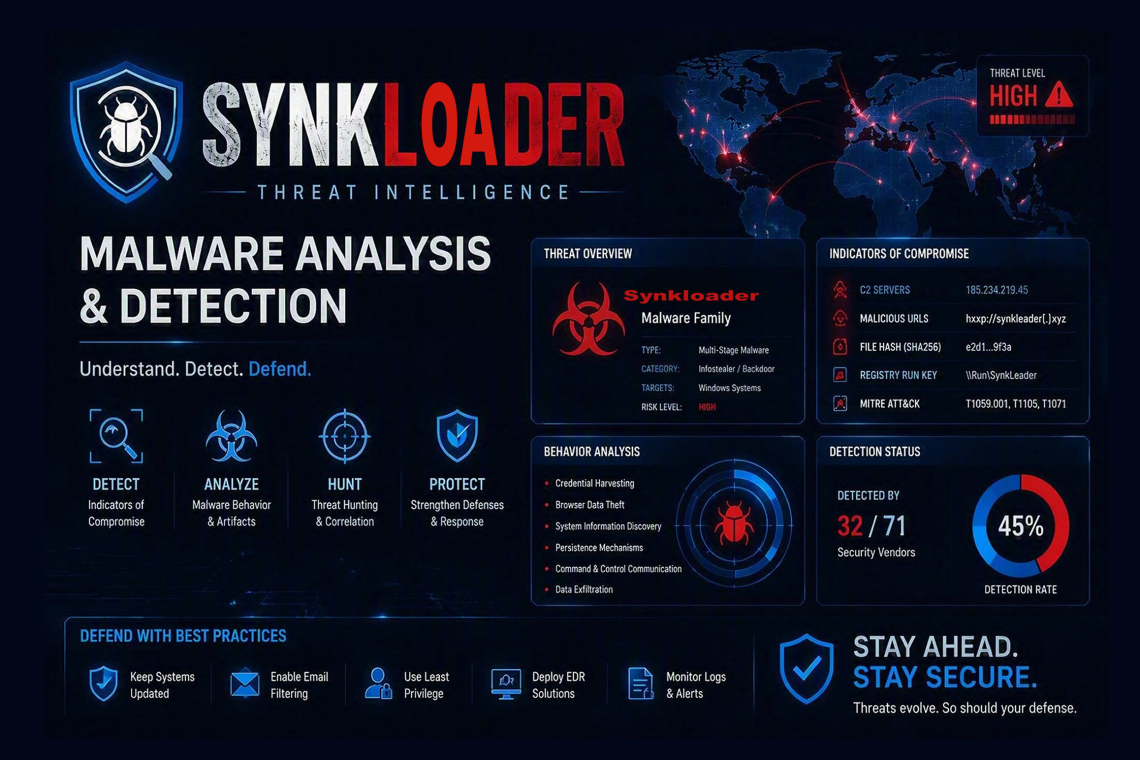
SynkLoader is a newly discovered malware framework that emerged in mid-2026 and is being actively distributed through social engineering campaigns targeting enterprise users. Unlike many traditional malware families that rely on malicious email attachments or software vulnerabilities, SynkLoader abuses trusted workplace communication channels, particularly Microsoft Teams, by impersonating internal IT support personnel and convincing users to install malicious software. turn2search2
What makes SynkLoader especially dangerous is its combination of sophisticated social egineering, modular malware architecture, credential theft capabilities, remote access functionality, and the abuse of legitimate Microsoft infrastructure such as Azure-hosted files and Microsoft 365 tenants. Researchers believe the framework may serve as an initial access platform for ransomware operators or cybercriminal groups seeking long-term access to corporate networks. turn2search4
The Origin of SynkLoader
SynkLoader was first identified by security researcher at Expel during an incident investigation in August 2026. Analysis of malware timestamps and compilation metadata suggested that development and deployment likely began around July 28, 2026, making it a relatively new threat family. turn2search3
The malware's name, "SynkLoader," was chosen because of its unusual design philosophy. ather than relying on a single programming language, the framework combines Python, PowerShell, C#, and C++ components, often utilizing multiple languages within a single module. This "everything but the kitchen sink" approach complicates analysis and detection efforts while increasing operational flexibility. turn2search3
Researchers believe SynkLoader was developed by operators experienced in post-compromis activities. The malware's focus on reconnaissance, credential theft, persistence, proxying, and remote administration closely mirrors tools typically used by Initial Access Brokers (IABs) and ransomware affiliates. turn2search4
The Attack Chain
Phase 1: Establishing Trust
SynkLoader attacks commonly bein with direct communication through Microsoft Teams. Attackers create Microsoft 365 tenants and impersonate corporate IT support staff, often presenting themselves as members of a company's help desk team. turn2search3
Rather than relying on phishing emails that users may already distrust, attackers explot the perceived legitimacy of internal collaboration tools. Employees are more likely to trust messages appearing to originate from IT personnel within a platform they use daily. turn2search6
A typical message may claim that:
- The user's account requires verification
- Securit issues have been detected
- A system cleanup is necessary
- A PowerShell maintenance tool must be installed
These requests are framed as routine support actions, reducing suspicion and encouraging compliance. turn2search6
Phase 2: Malicious Software Delivery
Victims are instructed to download a filecommonly disguised as a utility called "PowerShell Cleaner." The file is distributed as an MSI installer and hosted on Microsoft Azure infrastructure. turn2search2
The use of Microsoft-hosted storage is particularly effective because:
- Azure URLs apear legitimate.
- Security-conscious users often trust Microsoft domains.
- Traditional reputation-based filtering may not immediately flag the download.
By leveraging trusted infrastructure, attackers avoid many of the red flags traditionally associated with malware distribution. turn2search6
Phase 3: Loader Deployment
Once executed, the installer deploys several componnts, including:
- PowerShell scripts
- Embedded Python runtime environments
- Malicious Python scripts
- Fake Microsoft runtime DLLs
- Additional C# and C++ modules
Many payloads execute directly in memory, reducing forensic artifacts and limiting opportunities for endpoint protection systems to identify suspicious files on disk. turn2search8
The malware establishes communications with command-and-control (C2) servers and beginsprofiling the victim environment for potential exploitation opportunities. turn2search5
Architecture and Technical Design
One of SynkLoader's most notable characteristcs is its multilingual architecture.
Security researchers observed the malware seamlessly switching between:
- Python
- PowerShell
- C#
- Native C++
within various stages of execution. turn2search2
The design offers several advantages to attackers:
Evasion
Defensive solutions ofen focus on behavioral patterns specific to particular languages or frameworks. SynkLoader's mixed-language architecture makes those patterns harder to identify. turn2search8
Modularity
Operators can selectively deploy capabilities based on victim value andoperational objectives. turn2search2
Reduced Detection
Python-based execution remains less common among Windows malwarefamilies, potentially generating fewer behavioral alerts in certain environments.
Major SynkLoader Modules
1. System Profiler
The profiling component gathers:
- Hostname
- Username
- Privilege levels
- Running processes
- Services
- Domain information
- Active Directory statistics
This information helps attackers evaluate whether the target organization is worth further investment. turn2search2
2. Persistence Module
To survive reboots and logoffs, SynkLoader creates randomly named scheduled tasks configured to launch malware components repeatedly. turn2search2
Persistence ensures that attackers maintain access even if users restart their systems r terminate visible processes.
3. PhishLocker
Perhaps the most interesting SynkLoader capability is PhishLocker.
This module presents a highly convincing imitation of the Windows 11 lock screen. Users believe they are reauthenticating to Windows when entering their password. Instead, their credentials are transmitted directly to attackers. turn2search8
Unlike credential dumping tools such as Mimikatz, PhishLocker captures legitimate user input, making the compromise harder to detect and potentially bypassing certain credential protection mechanisms. turn2search3
4. TrafficRedirector
TrafficRedirector functions as a reverse proxy.
It allow attackers to:
- Route traffic through compromised systems
- Access internal services
- Circumvent IP-based restrictions
- Blend malicious activity with legitimate network traffic
This capability can assist lateral movement and covert operations within enterprise environments. turn2search8
5. Interactive Shell
The Remote Access Trojan (RAT) module provides attackers ith interactive PowerShell command execution. turn2search2
Capabilities include:
- Executing commands
- Gathering intelligence
- Modifying system
- Launching follow-on attacks
6. StreamMaster
StreamMaster provides VNC-like functionality that enables:
- Desktop streaming
- Remote keyboard input
- Remote mouse control
This effectively grants adversaries live access to victim systems. turn2search2
Why SynkLoader Is a Serious Threat
Human-Centric Attack Strategy
SynkLoaderdemonstrates a broader trend in cybercrime: attackers increasingly target people rather than software vulnerabilities. By exploiting trust in IT departments and collaboration platforms, attackers bypass many technical defenses. turn2search6
Trusted Infrastructure Abuse
The campaign leverages legitimate Microsoft platforms,including Azure and Microsoft 365 services. Security teams often struggle to distinguish malicious activity from legitimate cloud usage. turn2search2
Enterprise Network Focus
Its Active Directory enumeration, credential harvesting, ad remote administration capabilities indicate a clear focus on corporate environments rather than individual consumers. turn2search9
Potential Ransomware Connection
Multiple researchers have noted that SynkLoader exhbits many characteristics associated with ransomware precursors and Initial Access Broker operations. The framework appears optimized for establishing and maintaining footholds before follow-on attacks occur. turn2search4
Defensive Recommendations
Organizations should take the following steps:
Strengthen Teams Security
- Restrict external Teams communications where possible.
- Implement tenant allowlists.
- Monitor new external contacts.
Verify IT Requests
- Require out-of-band validation of software installation requests.
- Establish formal IT support procedures.
Improve Security Awareness
- Train employees to recognize Teams-based phishing.
- Educate users about fake IT support scenarios.
Harden Endpoint Controls
- Monitor PowerShell activity.
- Restrict unauthorized MSI execution.
- Enable application control policies.
Implement Strong Authentication
- Enforce MFA across all accounts.
- Use phishing-resistant authentication methods where available.
Monitor for Indicators
- Unusual scheduled tasks
- Unexpected Azure-hosted downloads
- PowerShell execution chains
- Remote administration activity
Conclusion
SynkLoader represents a significant evolution in modern cyber threats. Instead of relying on software exploits, it combines trust abuse, cloud-hosted delivery, credential theft, persistence, remote access, and modular malware techniques into a highly effective attack framework. Its use of Microsoft Teams as a primary infection vector highlights how collaboration platforms have become attractive targets for cybercriminals. turn2search6
While SynkLoader is a newly emerged threat, its architecture and operational methods sugest it may become an important tool for ransomware actors and initial access brokers. Organizations that rely heavily on Microsoft 365 and Teams should treat this malware as a warning that trusted communication channels are now part of the enterprise attack surface and require the same scrutiny as email and web traffic.
Found this article interesting? Follow us on X(Twitter) ,Threads and FaceBook to read more exclusive content we post.
