
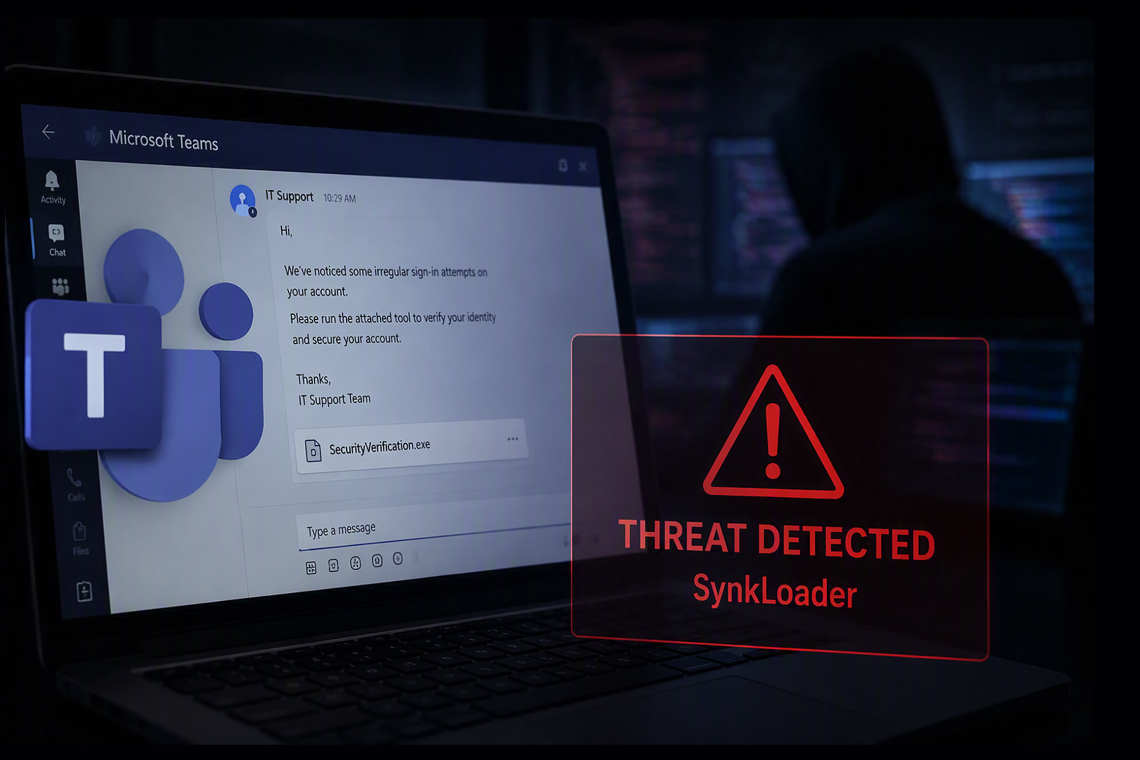
Cybercriminals are increasingly moving away from traditional phishing emails and instead targeting employees through trusted workplace communication platforms. One of the latest examples is SynkLoader, a malware campaign identified by ReliaQuest Threat Research that leverages Microsoft Teams, voice phishing (vishing), and IT support impersonation to infiltrate corporate environments.
Unlike conventional malware attacks that rely on exploiting software vulnerabilities, SynkLoader focuses on exploiting human trust. Attackers pose as internal IT personnel and persuade users to install what appears to be a legitimate troubleshooting tool. This approach allows threat actors to bypass many traditional security controls designed to detect malicious emails and suspicious websites.
How the Attack Works
The attack typically begins with a Microsoft Teams message or a phone call from an individual claiming to be a member of the organization's IT support team. The attacker informs the victim of an alleged technical issue and offers assistance to resolve it. To fix the supposed problem, the victim is instructed to download and execute a file named"PowerShell Cleaner." The installer is often hosted in Azure Blob Storage, a legitimate Microsoft cloud service. Because Azure is commonly used by organizations for file storage and application hosting, victims may view the download as trustworthy and legitimate.
Once the MSI installer is executed, the attack moves into its next phase, initiating SynkLoader without requiring malicious email attachments or compromised websites. This technique capitalizes on users' tendency to trust collaboration platforms such as Microsoft Teams more than traditional email communications.
Advanced Evasion Techniques
SynkLoader is not a typical malware loader. ReliaQuest researchers describe it as a hash-gated PowerShell loader designed to frustrate security analysis and evade automated detection systems. Before executing its payload, SynkLoader decrypts components in memory and validates them against cryptographic hashes. If any modification is detected, execution stops immediately. This validation process makes it difficult for researchers and sandbox environments to observe the malware's full behavior. Many automated analysis systems may never trigger the complete infection chain because the malware detects that it is running under unusual conditions.
Following successful execution, SynkLoader deploys a Python-based backdoor capable of retrieving additional functionality from command-and-control (C2) infrastructure as needed. By keeping capabilities off the initial payload and retrieving them dynamically, attackers reduce the amount of information available during static analysis and make detection significantly more challenging.
Why SynkLoader Is Dangerous
The most significant aspect of SynkLoader is its reliance on trusted enterprise tools and familiar processes. Employees are typically trained to recognize suspicious emails but may be less cautious when interacting with messages received through collaboration platforms or from individuals claiming to represent internal IT support.
This mirrors a broader cybersecurity trend identified by ReliaQuest, where attackers increasingly exploit trusted identities, tools, and business processes rather than relying solely on technical exploits. According to ReliaQuest's threat intelligence findings, social engineering has become one of the most effective methods for gaining initial access into corporate environments.
The campaign demonstrates how even a short conversation with a convincing attacker can result in malware installation, credential theft, remote access, and potentially larger compromises within the organization.
Potential Impact on Organizations
If successfully deployed, SynkLoader can provide attackers with a foothold inside a corporate network. Subsequent payloads may enable:
- Credential theft
- Remote access to endpoints
- Network reconnaissance
- Lateral movement
- Persistence mechanisms
- Data exfiltration
- Ransomware deployment
The malware's use of PowerShell and Python, combined with memory-based execution techniques, makes forensic investigation more difficult and allows malicious activity to blend into legitimate administrative operations.
Recommended Mitigation Strategies
Organizations can reduce their exposure to SynkLoader and similar social engineering campaigns by implementing the following measures:
1. Verify IT Support Requests
Employees should independently validate unexpected support requests through established help desk procedures before installing any software.
2. Restrict External Teams Communications
Limit communications from unknown or unauthorized external Microsoft Teams users whenever possible.
3. Monitor MSI Executions
Security teams should monitor and alert on MSI installers launched from user directories, cloud-storage locations, or other unusual sources.
4. Enhance PowerShell and Python Monitoring
Unusual PowerShell and Python activity should be closely monitored, logged, and investigated.
5. Implement Application Control
Use application allowlisting to prevent unauthorized installers and scripts from executing within the environment.
6. Strengthen Security Awareness Training
Training should specifically address Teams-based social engineering, fake IT support interactions, and cloud-hosted malware delivery techniques.
Conclusion
SynkLoader represents the evolution of modern cyber threats, where attackers increasingly focus on exploiting trust rather than vulnerabilities. By combining Microsoft Teams impersonation, vishing attacks, legitimate cloud infrastructure, and advanced malware evasion techniques, threat actors have created a highly effective method of bypassing traditional security defenses. Organizations must recognize that trusted communication platforms can be abused just as easily as email and implement both technical controls and user education initiatives to defend against these emerging threats.
Found this article interesting? Follow us on X(Twitter) ,Threads and FaceBook to read more exclusive content we post.
