
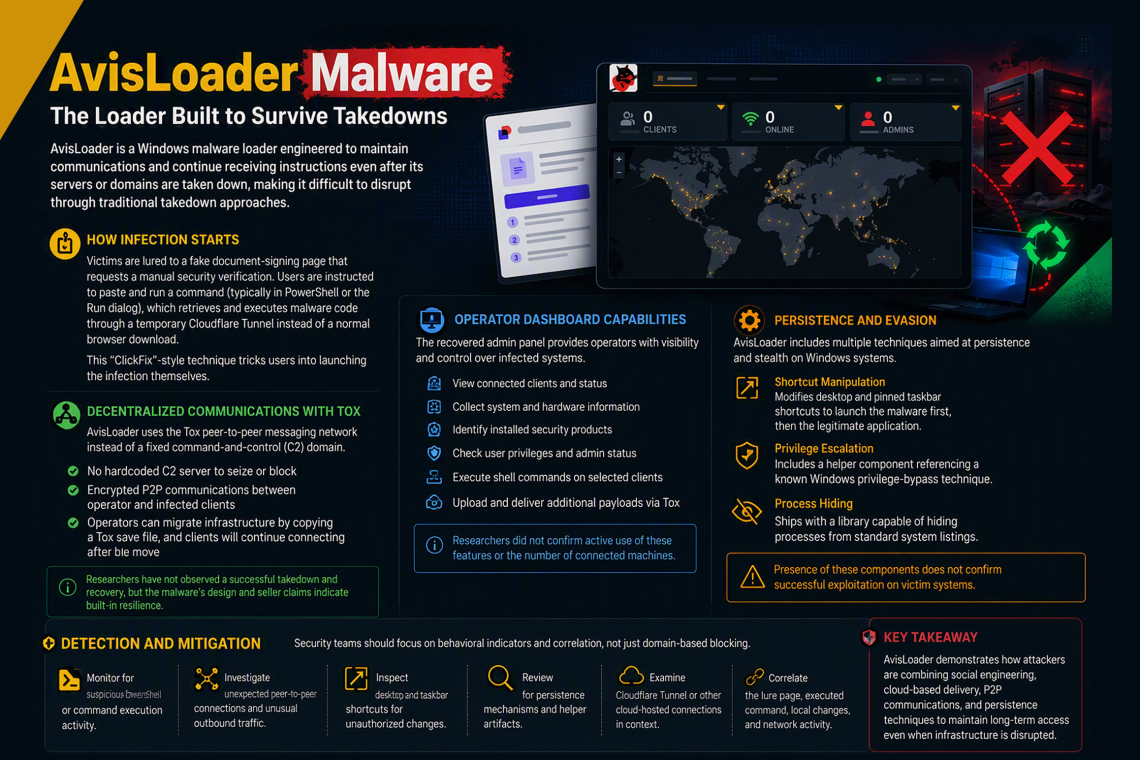
AvisLoader is a sophisticated Windows malware loader engineered to remain operational even when its command-and-control infrastructure is disrupted. Unlike traditional malware that depends on a fixed server or domain for instructions, AvisLoader is designed to continue receiving commands after server takedowns, making it far more difficult for defenders to neutralize simply by shutting down malicious websites.
The infection chain begins with a fraudulent document-signing webpage that prompts visitors to manually execute a command on their systems. What appears to be a routine verification step is, in reality, a carefully disguised malware delivery mechanism. The site claims that a third-party security service is handling the verification process, but instead of validating the user, the supplied command downloads and executes malicious code through a temporary tunneling service rather than a conventional browser download.
This technique closely resembles the fake verification and ClickFix-style social engineering campaigns that have gained popularity among cybercriminals. Rather than exploiting software vulnerabilities, the campaign tricks users into launching the attack themselves. Researchers at Varonis Threat Labs uncovered AvisLoader on an exposed staging server containing phishing lures, supporting components, and an operational control panel.
.webp)
AvisLoader advertised for sale on a cybercrime forum (Source – Varonis)
A key feature that sets AvisLoader apart is its use of encrypted peer-to-peer communications. Instead of relying on a static domain name or dedicated command server, the malware leverages the Tox messaging network to receive instructions and additional payloads. This architecture eliminates the single point of failure that security teams typically target during takedown operations.
The discovery highlights a mechanism for maintaining long-term access to compromised systems rather than evidence of a widespread malware outbreak. Researchers have not disclosed victim counts, but the recovered infrastructure demonstrates how attackers can create a remotely manageable Windows client capable of receiving future commands, updates, and malicious files.
Resilient Command-and-Control Architecture
Traditional malware operations often collapse when defenders seize or block the domains and servers used for command-and-control communications. AvisLoader addresses this weakness by embedding Tox peer-to-peer messaging functionality directly into its Windows executable.
Because communications occur through a decentralized network, the malware does not require a fixed control server that can be easily identified and shut down. Advertisements for AvisLoader on underground cybercrime forums even claimed that operators could seamlessly migrate control infrastructure by copying a Tox save file, allowing infected clients to continue recognizing and communicating with the same operator identity after migration.
While researchers have not observed an actual recovery following a takedown event, the malware's architecture clearly demonstrates a design intended to withstand infrastructure disruptions. However, this resilience does not make AvisLoader invisible. Security teams can still identify suspicious device behavior, unusual outbound connections, and other indicators of compromise.
The malware delivery process and command infrastructure are intentionally separated. Initial payload delivery is facilitated through a Cloudflare Tunnel, while ongoing communication occurs over the Tox network. The recovered operator dashboard includes detailed information about connected systems, including hardware details, security software, administrator privileges, and client status.
The management interface also enables operators to queue shell commands for execution when infected devices reconnect. In addition, a dedicated file transfer section allows attackers to distribute secondary payloads through the Tox network. Researchers have not confirmed whether these capabilities were actively used against victims or how many endpoints may have connected to the infrastructure.
Persistence, Evasion, and Additional Capabilities
The recovered malware sample is a 64-bit Windows executable measuring approximately 3.4 MB. It launches with the privileges of the user who executes it and contains several components that suggest an emphasis on persistence and stealth.
Among the most notable findings is code designed to modify desktop and taskbar shortcuts. By altering existing shortcuts, the malware can launch itself whenever a user opens a legitimate application. The intended application then opens normally, reducing the likelihood that the victim notices any suspicious behavior.
Researchers also discovered bundled utilities associated with privilege escalation and process-hiding techniques. One component references a known Windows privilege bypass method, while another appears capable of concealing selected processes from standard system listings.
Importantly, these findings represent potential capabilities rather than confirmed attack activity. Investigators have not verified that privilege escalation was successfully achieved or that process-hiding functionality was deployed against real-world targets. The recovered components simply reveal functionality available to operators.
Detection and Defensive Recommendations
Organizations can reduce their risk of infection by treating any document-signing, verification, or authentication page that instructs users to paste commands into a terminal, PowerShell window, or Windows Run dialog as highly suspicious.
Security teams should monitor for:
- Unexpected PowerShell or scripting activity.
- Suspicious peer-to-peer network communications.
- Connections to unfamiliar cloud-hosted infrastructure.
- Modified desktop and taskbar shortcuts.
- Unusual file artifacts associated with persistence mechanisms.
- Execution patterns that do not appear as direct child processes of web browsers
.webp)
The AvisLoader dashboard (Source – Varonis)
Defenders should avoid relying solely on domain-based detection and blocking. Since services such as Cloudflare Tunnels have many legitimate uses, blanket blocking may not be practical. Instead, analysts should correlate multiple indicators, including the phishing page, executed commands, local system modifications, and network activity, to identify potential compromise.
AvisLoader demonstrates how malware developers are increasingly adopting decentralized communication methods and user-driven infection techniques to improve operational resilience. By combining social engineering, cloud-based delivery mechanisms, peer-to-peer command channels, and persistence-focused features, the loader represents a growing challenge for traditional disruption and takedown strategies.
Found this article interesting? Follow us on X(Twitter) ,Threads and FaceBook to read more exclusive content we post.
