
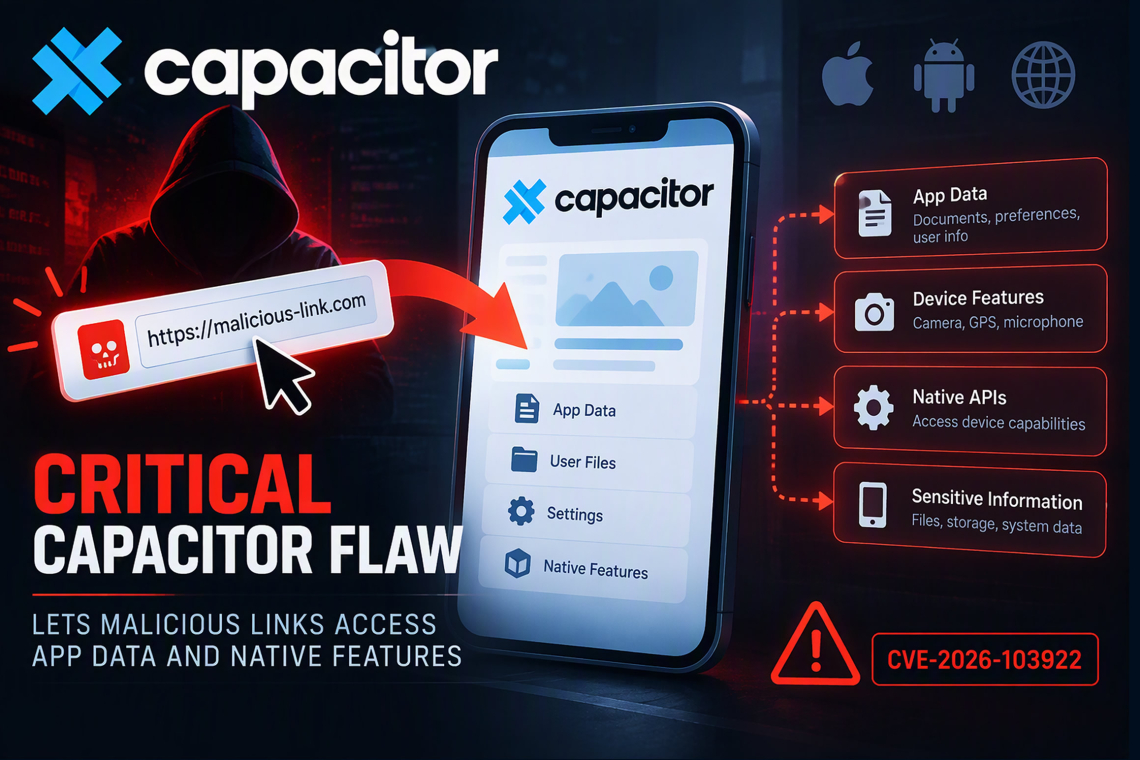
A newly disclosed critical security flaw in Capacitor, the popular cross-platform framework used for Android and iOS applications, could allow attackers to abuse specially crafted links to load malicious content within an application's trusted security context. If successfully exploited, the issue could expose sensitive application data and provide unauthorized access to native device functionality through Capacitor plugins.
Tracked as CVE-2026-103922, the vulnerability carries a CVSS score of 9.6, reflecting its severe potential impact on affected mobile applications. Security researchers warn that attackers could leverage the flaw to execute malicious web content while inheriting the same privileges as legitimate application pages.
How the Vulnerability Works
The issue originates from a weakness in Capacitor's WebView navigation protections. While the framework validated the scheme and host portions of requested URLs, it failed to properly verify the URL path. This oversight made it possible for attackers to abuse an internal endpoint known as /capacitor_http_interceptor, which operates under the application's trusted origin.
By crafting a malicious link that references this internal endpoint while supplying an attacker-controlled external URL, threat actors can trick the application into loading untrusted content through Capacitor's native networking layer.
When a user opens the malicious link from within the vulnerable application, the native layer retrieves the attacker-controlled content and delivers it back to the WebView. Because the response is presented under the application's legitimate origin, the malicious page gains the same-origin privileges normally reserved for trusted application content.
Access to Sensitive Data and Native Features
The security implications are significant.
Since the malicious content is treated as trusted by the application, embedded scripts can potentially:
- Read data stored in localStorage
- Access authentication and session cookies
- Interact with Capacitor plugin APIs
- Retrieve user information stored by the application
- Access files and device resources
- Abuse application-specific functionality
- Extract authentication tokens and credentials
The exact scope of compromise depends on which Capacitor plugins are enabled within the affected application. Applications that expose device capabilities through plugins may inadvertently provide attackers with access to sensitive resources such as:
- Camera functionality
- GPS and location services
- Microphone access
- File storage
- Push notifications
- Authentication services
- Enterprise application data
- Custom native APIs
Why the Vulnerability Is Particularly Dangerous
The flaw creates a breakdown of the security boundary that normally separates trusted application content from untrusted web content.
Applications that allow users to open or interact with externally supplied links are especially vulnerable. This includes:
- Messaging and chat platforms
- Social media applications
- Customer support portals
- Discussion forums and comment systems
- Collaborative platforms
- Rich-text editors and document viewers
- Embedded browsers
- Applications that display user-generated content
Although exploitation requires user interaction, the requirement is minimal. A victim simply needs to click or open a malicious link from inside the affected application for the attack chain to begin.
Plugin Disabling Does Not Eliminate the Risk
A particularly noteworthy aspect of the vulnerability is that the internal proxy component remained reachable even when the CapacitorHttp plugin was disabled.
As a result, organizations running vulnerable versions cannot rely on disabling the plugin as a mitigation strategy. Researchers noted that the vulnerable proxy handler could still process requests, leaving applications exposed despite attempts to reduce attack surface through plugin configuration changes.
Affected Versions
The vulnerability impacts multiple major release branches of Capacitor, including:
- Version 6.0.0 through 6.2.1
- Version 7.0.0 through 7.6.8
- Version 8.0.0 through 8.3.4
- Version 8.3.5 through 8.4.2
- Version 8.5.0
Applications built using these releases may remain vulnerable until updated and redistributed to end users.
Available Fixes
The vulnerability has been addressed in updated Capacitor releases. The vendor implemented several security enhancements, including:
- Blocking frame-based navigation to the internal proxy endpoint
- Limiting access to the proxy handler only when the CapacitorHttp plugin is explicitly enabled
- Preventing the handler from serving document and main-frame requests
- Preserving legitimate
fetch()andXMLHttpRequestfunctionality without exposing the dangerous behavior
Developers are strongly encouraged to upgrade to the latest patched version, rebuild their Android and iOS applications, and distribute updated releases through their respective app stores as soon as possible.
Recommended Mitigations
Organizations unable to immediately deploy updates should consider implementing temporary defenses, including:
- Creating a custom Capacitor plugin that blocks requests targeting
/capacitor_http_interceptor - Strictly validating and sanitizing all user-supplied URLs
- Restricting untrusted content from being rendered inside application WebViews
- Monitoring applications for suspicious navigation activity
- Reviewing exposed Capacitor plugins and limiting unnecessary permissions
Bottom Line
CVE-2026-103922 represents a critical same-origin bypass vulnerability that can transform a simple malicious link into a powerful attack vector against Capacitor-based mobile applications. By allowing attacker-controlled content to execute within a trusted application origin, the flaw opens the door to data theft, token compromise, and abuse of native device capabilities. Organizations and developers using affected Capacitor versions should prioritize patching immediately to prevent attackers from leveraging this weakness against users and enterprise mobile environments.
Found this article interesting? Follow us on X(Twitter) ,Threads and FaceBook to read more exclusive content we post.
