
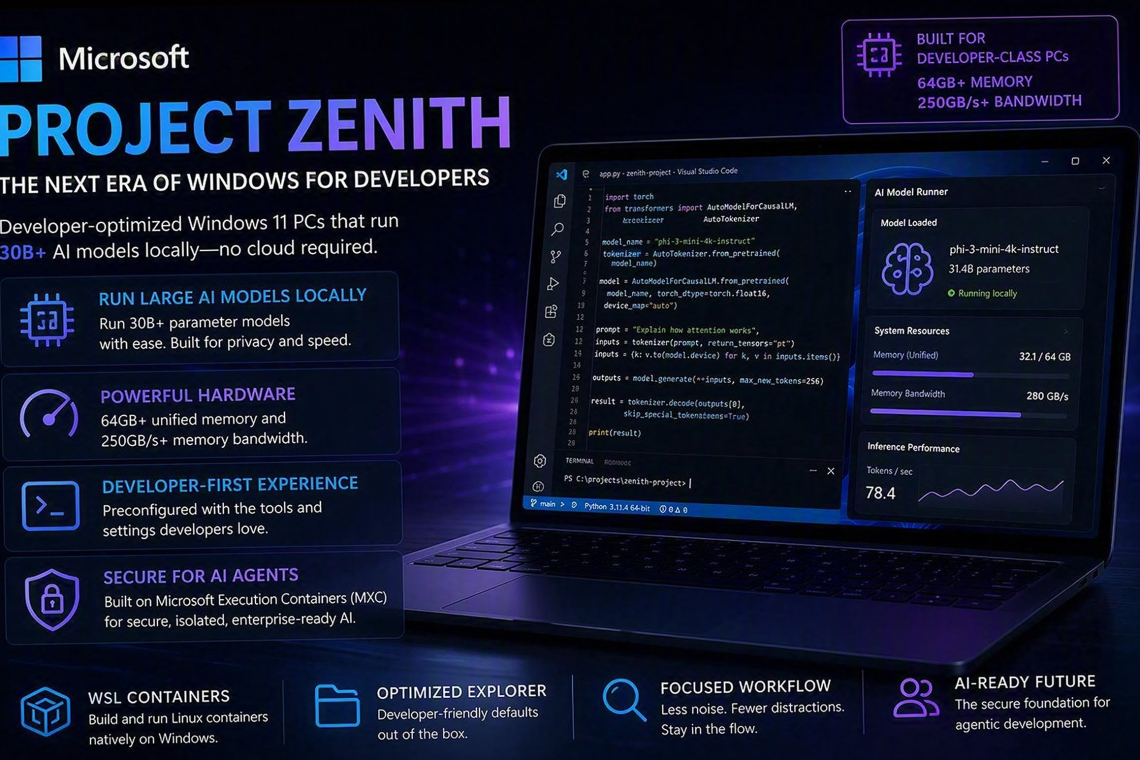
Microsoft has unveiled Project Zenith, a new Windows 11 initiative designed to give developers a streamlined, AI-focused computing experience on a new class of high-performance PCs. The project represents Microsoft's push toward running large artificial intelligence models directly on local hardware, reducing dependence on cloud-based AI services.
Initially announced following commitments made during Build 2026, Project Zenith is tailored for systems equipped with at least 64GB of unified memory and more than 250GB/s of memory bandwidth. These specifications enable developers to run AI models with over 30 billion parameters locally, eliminating cloud usage fees and token consumption for many development and experimentation tasks.
The first generation of Project Zenith systems will be powered by AMD's Ryzen AI Halo platform, with support from additional hardware manufacturers and silicon partners expected in the near future.
A Developer-First Windows Experience
Rather than being a standalone operating system, Project Zenith is a specialized Windows 11 configuration built on top of Microsoft's ongoing platform improvements. The environment incorporates enhancements already introduced across Windows 11, including updates to Search, File Explorer, and memory management, while adding developer-centric optimizations by default.
Key developer tools such as Windows Terminal and Visual Studio Code are pinned to the taskbar out of the box. Microsoft has also adjusted system settings across File Explorer, Search, Start, and the taskbar to create a more efficient coding environment.
File Explorer arrives preconfigured with features commonly enabled by developers, including:
- Visible file extensions
- Hidden file visibility
- Full path display in the title bar
- Long-path support
At the same time, distractions such as file recommendation prompts and synchronization notifications are minimized. Search and Start are optimized with Command Palette enabled and reduced notification noise, creating a cleaner and more focused workspace.
Enhanced Linux and Container Integration
Windows Subsystem for Linux (WSL) forms a core component of Project Zenith. Building on Microsoft's decision to open-source WSL, the new environment introduces integrated WSL Containers, allowing developers to create, run, and manage Linux containers directly within Windows without relying on external virtualization tools.
This tighter Linux integration is intended to simplify cross-platform development workflows while maintaining native Windows usability.
Built for the Era of AI Agents
Project Zenith devices are also designed with emerging agentic AI workflows in mind. Microsoft is leveraging its Microsoft Execution Containers (MXC) framework to support AI-powered development agents that can autonomously write, test, and execute code.
MXC combines isolation, identity enforcement, and enterprise management capabilities to help organizations securely deploy AI agents within controlled environments. Microsoft views this security foundation as essential as software development increasingly incorporates autonomous AI systems.
Shifting AI Development from Cloud to Device
Microsoft positions Project Zenith as both a technological and economic evolution in AI-assisted development. By running capable AI models locally, developers can perform everyday coding, testing, and experimentation tasks without relying on cloud infrastructure. More advanced cloud-hosted models can then be reserved for complex reasoning and specialized workloads.
According to Microsoft, Project Zenith will continue evolving through developer feedback while maintaining a consistent "ready-to-code" experience across a growing range of hardware from multiple OEM partners. The initiative signals Microsoft's broader vision of bringing powerful AI capabilities directly to Windows devices, enabling developers to build, experiment, and innovate with large language models without being tied to the cloud.
Found this article interesting? Follow us on X(Twitter) ,Threads and FaceBook to read more exclusive content we post.
